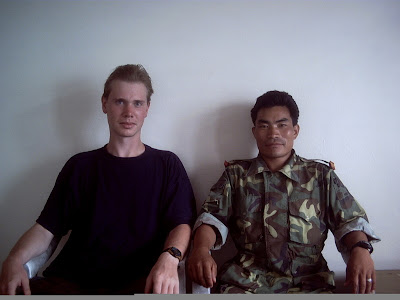
Neil Horning
Text of the interview with Pawan, the Mustang district in charge follows. I think it’s still a bit boilerplate.
1. The leadership has often said that the peace process was an unprecedented experiment for Maoism. In your opinion, what are the results of this experiment and the lessons to be learned?
When king Gyanendra used the Army to take power from the elected representatives We made the 12 point agreement in order to win back power with the help of all of the citizens. As we have been voicing the demands of the people, the old agreement was insufficient to fulfill these demands in the current situation so we are trying to make another agreement on the basis of a new consensus. The theme of this consensus must be to first announce a republic in order to uplift the different oppressed ethnicities genders regions and communities so they participate fully in the upcoming Constituent Assembly elections. For that the Communities of Women and Dalits must be given specific rights to participate in the interim government. Only then can the new Constitution be made in accordance to the will of the Nepalese citizens. This is the main aspiration of the Nepali Citizen today. Our party (Maoist) is always ready for that. Although we have joined the peace process, we are still integrating the strategies of People’s War and talks so there is less possibility of failure.
2. who do you think the public blames for the delay in the elections?
Since we started our People’s War to build the future of the Nepalese citizens we have waged the whole war for constituent assembly and we have written slogans on the walls saying “long live Republic, long live Constituent Assembly.” When we were doing this the Government [under the mainstream parties] arrested and even killed those people. And now the same people are blaming us for the delay. Shall we not remember that? Before the 19 day People’s uprising who was making the demands for Constituent Assembly and Republic? With this in mind, how can there be any confusion? Our 13,000 Martyrs sacrificed for Constituent Assembly and Republic so how can our party be against them? Therefore, those who were against them are the ones who are against Republic and Constituent Assembly.
3. What political development has most surprised you over the last year and a half?
Over the last year and a half we have concluded a huge ideological war. After the 12-point agreement we were able to isolate Gyanendra from the power of the Royal Army. Then we had the opportunity to speak freely among the Nepalese for whom we have been fighting for the last 11 years. As there is one army in this country of the government and one of the Nepalese citizens, we are able to force the government to give equal treatment to these two armies, as well as clear the charge made against us by the American imperialists that we are terrorists they had been popularizing to the world. Even now we are still trying to free the Nepalese government from the interference of European countries, America, and Australia who are exercising their hegemony. We are trying to balance the foreign strategies so we are not in the situation to be oppressed at their will. Our Party is the only party which is integrating all oppressed regions, ethnicities, genders, languages, cultures, all women and Dalits; understanding their sentiments in order to move them on the path of their liberation.
4. How have things changed for you personally over that time?
Things have changed so much since our last meeting because time is constantly moving [progressive]. According to that, human society is moving ahead. Therefor today’s Nepal is moving further ahead that yesterdays Nepal. In the same way, human society is becoming more conscious so there is a certainty of improvement. In the past there was an armed struggle of ideas. This category of struggle is not limited only to Nepal. It has become world wide because todays world has already become a fully integrated system. Finally, our ideological struggle is not only for Nepali citizens but rather for all the oppressed citizens of the world. Therefor, to have change in the politics of Nepal means to have change in the politics of the world.
Source: Blog for a Democratic Nepal, December 28, 2007