Google Groups
Subscribe to nepal-democracy
Email:
Visit this group

Monday, 14 January 2008

Test of resolve

The government on Friday announced April 10 as the fresh date for the election to the Constituent Assembly (CA). As they are used to postponements (first in June last year and then in November), it is not entirely surprising that many people appear still unsure that the event will come off on schedule. Many others, including politicos, are expressing doubts, whereas leaders of the three biggest parties - the Nepali Congress, the CPN-UML andthe CPN-Maoist - are striking optimistic notes. The CPN-Maoist, whose 22-point demand was the apparent cause of the deferral of the November 22 election, has decided to kick off its election campaign from tomorrow. The Election Commission has decided to implement the election code of conduct from the day after tomorrow. The new poll date has also given most of Nepal’s important friendly countries a measure of satisfaction — the US has already welcomed it.
But even then there is no dearth of doubters. Some may associate this lack of confidence with the SPA’s ‘lack of resolve’. Others suspect that as the monarchy will lose even its present suspended status with the election, its internal and external backers willnot look on but do their last bit to spoil the polls, by resorting to all possible means. The third principal source of doubt for many is groups like Janajatis and Madhesis who are pushing their various demands before the election, threatening to torpedo it unless they are satisfied. Particularly disturbing is the separatist overtones of some Tarai outfits. While the earlier agreements with them should be carried out, the government should not go on appeasing such groups.
What the government needs to keep in mind is that the various small groups in the Tarai have assumed oversize importance, because of its lack of timely and appropriate response. Unreasonable demands include the recall of all government employees not of ‘Madhesi’ stock from the Tarai, ‘right to self-determination’ and creation of the entire Tarai as a single state within the federal structure. Nowhere in South Asia, can such demands be fulfilled. Whether the election can be held on schedule will also depend, to a considerable extent, on how the government handles some of the Tarai or Janajati groups. Some Tarai groups have given the government the deadline of January 19 to meet their demands. The making offull proportionality a condition for the polls at this stage raises questions of intent. Its position should be to appeal to all groups to take part in the election. However, if any of them persists in boycotting it, let it do so, because it comes within democratic rights; but, under no circumstances can the government be expected to let anybody create the disturbancesto foil the CA election, for which the Nepali people have fought so long and so hard. If the government cannot keep the date this time, its claim to power will weaken, particularly of Prime Minister Koirala and the Nepali Congress, because they run the most important ministries and agencies necessary to hold the CA polls.
Source: The Himalayan Times, January 14, 2008

CA election : Settle political questions first

Shailendra Kumar Upadhyay
Once again the people have been assured by SPA government that Constituent Assembly polls would be held before the end of 2064 BS. This announcement has given people new hope. However, the Adivasi Janajati Mahasangh and the newly formed Tarai-Madhes Party have expressed dissatisfaction and blamed the government for ignoring their demands. This has compelled people to remain cautious and not get carried away.
The issues raised by Janajatis and Madhesis have to be addressed and resolved for holding of free and fair election participated by all sections of the population. Since failure to hold the polls twice has already tarnished the image of the government, further uncertainty would only add fuel to the question of its legitimacy and push the country towards anarchy. Therefore, certain tasks have to be accomplished before the ballot date.One of the main demands of dissident groups is an agreement about the rights of the units in the future federal state. In the Tarai region, there is demand for a single unit encompassing the whole Tarai region. There are also demands for a Tharu unit or units based on Maithili, Bhojpuri and Awadhi language-speaking areas. In order to resolve the issue, either a political conference of all stakeholders in Tarai (including the political parties) has to be held or a referendum should be called to determine the aspirations of the Tarai people.
Holding a referendum before the CA polls looks neither easy nor feasible; the only alternative is to hold a political conference. The other means could be holding a referendum simultaneously with CA election. It would put an additional burden on the Election Commission (EC) but would ensure larger participation of the people that would help the government take crucial decisions on the formation of new units composing a federal state. Since the interim constitution has already declared that the structure of Nepal would be federal, the constituent assembly has to determine the shape and size of federal units. An agreement among the stakeholders on the formulae for creation of new federal units, therefore, has to be found.
In the hilly areas, there seems to be an overwhelming desire among the public for the creation of federal units on the basis of dominant ethnic groups — that takes care of the language issue as well, as each ethnic group has its own language and culture. In the Tarai, however, the language issue and the issue concerning the cultural heritage of Tharu people remain sensitive. Naturally, in order to determine the aspiration of the sovereign people a mechanism has to be developed which does not hamper the constituent assembly election and also ensures peaceful, free and fair polls.
A new state structure in itself is not sufficient to build a new Nepal where all the citizens would have equitable share in policy-making and administration. The rights of an individual cannot be compromised on any ground. The essence of inclusive democracy is respect for the rights of every individual, no matter what community or group s/he belongs to and irrespective of the place s/he resides. There should be no move to evict any individual or group on any ground whatsoever and any such attempt must be punished as a criminal offence. The dominant groups would play the major role in the federal units but the minorities too would have their say as individuals and groups in a secure atmosphere. The issue of the right to self-determination has to be defined clearly and addressed in earnest. The people of each area under the federation ought to enjoy the right to determine the administrative, legislative and judicial apparatus, but not the right to secede, declare independence or merge with another nation. Abraham Lincoln, the most admired president of the then largest democracy, could not tolerate the act of secession by the southern states of the USA. The new units in the federation ought to have total control over their territories in all governance-related matters.Though we do not have sufficient time to linger in discussions, we have enough to convene a political conference on the limited agenda of formation of the new units and its basis and leave the details to be worked out by the constituent assembly in which all the stakeholders would have equitable participation. The need of the hour is to pay attention and show the willingness to accommodate the demands of Janajatis and Tarai in all seriousness.No amount of poll preparations will be enough to hold the election in peaceful, free and fair atmosphere unless the political questions are first resolved. The technical aspects of the polls have been laid out by the Election Commission well in advance, however the political aspects remain unresolved as yet. The only way to ensure polls is to motivate people to participate in the election with a clear mind that can weigh sensitive issues on their merit.
Source: The Himalayan Times, January 14, 2008

Wednesday, 9 January 2008

New hope for Nepal

Paul Soren

The prolonged confusion and apprehension over holding of Constituent Assembly (CA) elections and the issue of monarchy was partially resolved when the Seven Party Alliance (SPA) and Maoists signed a 23-point new agreement on December 23, 2007. This is fourth major agreement reached between the SPA and Maoists after the Jana Aandholan of April 2006. The interim government also approved the new pact which it is hoped will pave the way for the CA polls.
The interim parliament also passed an amendment bill to the interim constitution, declaring that Nepal would be a federal democratic republic after the CA polls. This will finally lead to the abolition of monarchy during the first sitting of the constituent assembly. It has also cleared the decks for the Maoists to rejoin the cabinet. The ball is now in the Maoists court and they have to make a move. They have to keep their commitments and join the democratic process and also ensure that polls are held on time.


For the present the new pact seems to be a good deal as it has cleared some of the existing political uncertainties and hiccups. This appears to be a tangible roadmap for a New Nepal. However, there are a few key questions which need to be further probed before making any conclusive statement. Will the 23-point pact pave way for timely CA polls and end the ongoing political crisis? The major demands of the Maoists have been addressed but what is the guarantee that they will sincerely participate in the polls? Will the Maoists come up with new set of demands to obstruct the CA polls? More importantly, will it address the Madhesi concerns and accommodate their political ambitions?
Analyzing it positively, it indicates that the new pact should be able to end the political stalemate in the country. The new agreement has primarily addressed two of the major issues obstructing the peace process and delaying the polls. The Maoists ’ demand for a republic and proportional representation has been met. Though the second Maoist demand for a full PR system has been partially met but it could still be acceptable to them. Similarly, in an effort to bring inclusiveness in the polity, the interim parliament also amended the constitution and increased number of members from 497 to 601. Thereby, 335 members will be elected under the proportional representation system, 240 members on first past the post system and 26 members will be nominated by the Prime Minister. It is expected that the amended constitution will be able to accommodate aspirations of the marginalised and deprived sections of the country. It should provide them an opportunity to represent their political viewpoint.
Despite all these positive trends, the government has several daunting tasks to perform. Firstly, it has to address the Tarai problem because elections cannot be held if the Tarai is left burning. Secondly, the security situation in the country is worrisome and need to be improved. The government has to take into account all these critical issues and address them on priority basis. Further and this is very important, the SPA members and Maoists have to stay united and stop playing the blame game. They need to co-operate with each other and find viable political solutions to the various problems the country. They also need to evolve a consensus over these issues and take them to their logical end.
Essentially the new deal enables the Maoists to rejoin the interim government by addressing two of their major demands. The rising aspirations of the Nepali people for peace and stability, require that political players play a leading role in establishing peace. They should also cooperate with other parties in sustaining the peace process. The Maoists credibility, will determined by their seriousness and adherence to their commitments. Manipulative politics and rigidity have to be replaced by transparency and flexibility in finding solutions to problems. The Maoists need to prevent their cadres (especially the Young Communist League) from indulging in terror and unlawful criminal activities. Any further attempts to stay away from the polls or creating obstacles in the holding of polls will rebound on them.
Since the institution of monarchy – controversial and meddlesome in politics -- has always been a focal point of debate in Nepali politics there has always been a struggle for power between the monarchy and democratic forces. The Maoists were the latest entrants in to this struggle to abolish what they described as a feudal institution. The new pact would eventually lead to the removal of monarchy in the country. The resultant amended constitution has empowered the parliament to abolish monarchy if the government suspects that the monarchy is playing a spoiler hand or intends to thwart the peace process. However, the Maoists would ensure that the monarchy is wiped out completely from the Nepali polity. The bill eases the government’s burden as it can now attempt to hold the polls by mid-April 2008.
There are a few negative aspects of the new pact and amended constitution. The new agreement does not directly address the ongoing Tarai problem inviting criticism from opposition party members and agitating Madhesi groups and the SPA and Maoists have been accused of taking arbitrary decisions. They alleged that common citizens have been deprived of their rights in the decision making process. It is true that the SPA and Maoists have neglected Madhesi aspirations by not addressing issues raised by them. It appears that the new pact is meant only to appease the Maoists rather than finding a political solution endangering the country. The SPA and Maoists have completely ignored that stability in Tarai is a very critical element for holding of a successful election. The Tarai problem if left unresolved has the potential to further complicate the peace process and aggravate the situation. Therefore resolving the Madheshi problem should be of the utmost importance for the government and parties.
The new agreement is an opportunity for the parties and Maoists to end the ongoing political crisis and will be a feasible roadmap for creating a new Nepal provided the SPA and Maoists can give up their petty political interests and exhibit the political will to address some of these pertinent issues like the Tarai problem and avoid delaying the polls. Most importantly, the SPA and Maoists have to create a conducive environment for the success of the polls.


Source: Observer Research Foundation, New Delhi, January 7, 2008

Saturday, 5 January 2008

Madhesis have a right to declare independence

Former Minister of Science and Technology Mahanta Thakur left the interim government to form a new party. He began his career in politics as a student leader in the early 1970s. He contested the general elections from Siraha. After having been a member of the Nepali Congress for more than 37 years, Thakur left the NC at a time when the party needed him most. Thakur does not believe the government can hold the CA polls in mid-April because of the deteriorating law and order situation in the tarai. Thakur spoke with Puran P Bista and Kamal Raj Sigdel of The Kathmandu Post on the future political course of his party and his demand for greater autonomy with a provision for self-determination.
Excerpts:
Q: You have formed a new party right after the SPA agreed to hold the CA elections by mid-April. Is your new party prepared and in a mood to participate in the polls?
Mahanta Thakur: We are not against the government's plan to hold the CA elections by mid-April. But the people in the tarai want to see their issues settled first. Elections are a constitutional process to express your views in a peaceful manner; but having said that, the current situation in the tarai is not conducive to holding elections. Peace and security are prerequisites for holding the polls.

Q: You have also expressed dissatisfaction with the 23-point agreement struck recently by the SPA. Is this a prelude to your boycotting the CA elections possibly to be held in mid-April?
Thakur: We have not protested against the agreement. There is a burning problem in the tarai right now, but the SPA is ignoring it and going ahead with its own agenda with a one-track mind. This has created enough room for suspicion. All the major political parties are well cognizant of the problems in the tarai and what's going on there. There is state-sponsored terrorism. Incidences of extortion and abduction are daily affairs. Violence has increased. In such a situation, I think the general people of the tarai don't want the election to be held. First, there should be peace, the violence must stop, and the issues settled.

Q: You mean you do not believe the CA polls will be held in mid-April as the SPA is preparing to announce.
Thakur: That's what the people of Madhes have been saying. We are planning to visit the tarai and tour all the districts. And we will decide accordingly. We will collect information about the problem in the tarai by sitting down face-to-face with the local people. If the government and others cooperate with us and peace is restored, we can hold the elections.

Q: You have named your party Tarai-Madhes Loktantrik Party. How do you define tarai and Madhes? Who are the Madhesis according your definition?
Thakur: This is just an illusion. Both terms are being used interchangeably. There is no difference in their meanings. And there is no politics hidden behind that.

Q: When you define Madhes and Madhesis, do you include all the people of different origins and castes presently living in the tarai?
Thakur: We have always talked about the tarai and the hills in a holistic manner. We are talking about the 49 percent of the national population living in the tarai. We have raised overall issues. We have not talked about a certain caste, origin or religion.

Q: You mean you are raising a regional issue as opposed to a racial one.
Thakur: Yes. We have raised the issues of a geographical area, not of a certain caste or a certain party.

Q: Is this reflected in the way your party has been formed, for instance, in its membership?
Thakur: They will be incorporated in the organization in due course.

Q: You have been a devoted Nepali Congress leader since you joined politics. But you resigned abruptly and formed a new party. There are a number of parties with different ideologies already operating in the tarai. Can you, as an ex-NC leader, take them into confidence?
Thakur: All the parties are trying their best and want to solve the problems of Madhes and Madhesis. Since we all have a common goal, we have come together. Now we all agree that this problem should be solved peacefully. This is in the interests of the nation and the people.

Q: There are different parties in Madhes; some armed, some unarmed. How would you characterize them?
Thakur: Our party has stated clearly that all the political groups fighting for the Madhesi cause should come together. We are making efforts towards that end. If we advance together, there will be less problems for the people, they will get relief, also less effort will be required. We have publicly appealed to everybody to unite for the cause. As part of our campaign, we held consultations with the tarai parties before we established our party. We will have formal talks with them now that we have formed a party. Then we will go ahead with some coordinated programs. They have agreed informally that we need to act together.

And as for those who are operating underground, we have not yet talked to them face-to-face. But they have expressed their appreciation and welcomed our initiative through different media in the tarai. They have congratulated us. We have taken it positively. We will meet them and request them to join our peaceful movement.

Q: Judging by the fact that Upendra Yadav of the MPRF and several others did not attend your party's inauguration, it appears that your party will also become just another in the procession of parties that have emerged in the tarai. In such a situation, how will you be able to add new dynamism to the Madhesi movement?

Thakur: We will have formal talks with them to finalize matters.

Q: Do you think that the armed groups operating in the tarai will join open politics if the demands that you and other unarmed political groups have been raising are fulfilled?

Thakur: They are in politics even now. They are different only in their approach. Since they are raising political issues, we must say it is politics. It's only the way they are doing it that is different.

Q: Different parties in the tarai have been raising different demands. You have come up with your own. So what are your party's demands?
Thakur: We want complete autonomy. The local people should be involved in running the local administration. This is not happening at present. Everything is run by the center. The Madhesis do not see their reflection in the faces that are sent there to handle the local administration. For this reason, the people in the tarai do not feel ownership of the administration. They are not in a position which allows them to say, “This is our government, and it serves us.” What is lacking is participation and autonomy.

Q: Do you think all these demands should be fulfilled before the CA polls? How practical would it be in that case?
Thakur: The people of the tarai think that it would be better if these issues are settled before the CA polls. But I think the CA is also a valid process to get our demands fulfilled. A part of our problem will be solved if the election reflects our sizeable representation. I take the CA polls as an opportunity too.

Q: The recent 23-point agreement states that the CA will contain 601 members and that the tarai will be well represented. Don't you think that this new development ensures what you are demanding in advance?
Thakur: There have been discrepancies in what is said and written. But I said that the CA was also an opportunity. It is not that we can solve all the problems at once. We can also solve some of the problems by using that legitimate process. We think this is a legitimate process and we must accept it. Why should we avoid it? But there is no such situation in the tarai for holding the elections.

Q: What are the conditions that can bring you to the CA?
Thakur: People have been clamoring that we do not believe the government can hold the elections peacefully and that their demands will be fulfilled. So our demands, such as autonomous government and Madhesi participation in the local administration, should be fulfilled. And there is truth in our demands. Every time tarai issues are raised, they get sidelined. Though the government has made some commitments, nothing has been implemented in practice to this date. The posts of CDO, police chief and various administrative officials are still occupied by a single elite community. So the people are not convinced that the government will ensure equality and bring immediate changes in our administrative and judiciary systems.

Q: Would it be possible to reform overnight the entire system that was established by the Rana oligarchy and cultivated by the Panchayat system? How should the government revamp the whole system before the CA polls?
Thakur: The government should demonstrate its commitment by acts that will convince the people that their demands will ultimately be fulfilled. The people should be assured that there will be no more extortion. For example, the police come to innocent people's houses at night and intimidate them for no reason. They are subjecting the people to extortion. They take away people's guns even if they have a license.

Q: Don't you think that the CA is the right mechanism to solve all the problems?
Thakur: The CA is an issue that is raised time and again strategically. We were not the ones who postponed the CA polls. Neither can we do that. Now all the arrows are directed at Madhes. The seven political parties quarrel among themselves and the blame is placed on us.

Q: It is said that the NC has sent you to the tarai with this new party to undermine other parties such as the Maoists that have taken hold there.
Thakur: There is not a grain of truth in that.

Q: But how could you have left the NC? You have been a NC leader your whole life.
Thakur: I have left the NC. We have formed a new party.

Q: Like all the other armed and unarmed groups in the tarai, your party has also demanded the right to self-determination. What is this “right to self-determination” in plain language?
Thakur: Regardless of whether you write it down or not, it is there. But once stated, it becomes a legitimate right of the people. If the government continues to suppress the tarai, then it is the people's right to warn it that they have a right to self-determination. Till now we have been talking about living together. But if you suppress us any longer, we have a right to declare independence and live separately.

Q: Since everybody has agreed on establishing a federal republic, Madhes too will have its own provincial government. So who will be there to continue “suppressing” you in a federal system? Won't it make your demand for “right to self-determination” redundant?

Thakur: Yes, that is possible. There are examples we can draw from other countries. Suppression can continue even after a state has been granted autonomy. There are examples of states that have separated and declared independence, and also of some that have rejoined the federation.

Q: You mean self-determination similar to the Kashmiri demand?
Thakur: That is a different case.

Q: When you are talking about self-determination, does it indicate that we are heading towards disintegration?
Thakur: I don't think that guaranteeing a state all its rights can lead to disintegration. A community with such rights becomes stronger, thus there is no chance of it breaking up. When inequality exists, the chances of disintegration are greater. For instance, several independent countries came together to form the European Union. They are working together; they have a common currency and common market and share many things. Though there are instances of disagreement among them, they are working hard to stay together. The suspicion that the country could break up is only a fear.

Q: There are several castes and groups—for instance, Tharus, Limbus, Kirats, Brahmins, Chhetris and others - among whom some have been demanding their own states while others have been demanding their representation in state affairs. How do you address their concerns?
Thakur: We are raising overall issues. We have not raised a particular community's issue. Just like when the British Empire was pulling out of India, they were more worried about the problems of the suppressed community than the Indians themselves. They could not solve the problem of the suppressed community during their reign, and when it was time to leave, they worried how the Indians could solve them.

The colonial forces who were leaving India were more worried about it than the Indians themselves. That is what is happening in our country too. The government did not show any interest in solving the tarai's problems before, but now they are worrying about how Madhes can solve the problems and issues of other communities. They are focusing more on this. We are talking about the entire tarai. We are not taking about any caste or community. We are talking about 49 percent of the national population.

Q: Have you held talks with other disgruntled groups, such as Janajatis and others who are also legitimate political forces in the tarai?

Thakur: We are in the process of holding discussions with such discontented groups.

Q: Can you include them in your program?
Thakur: No, we are not raising caste specific issues [as the Janajatis have been doing]. We are talking about a geographical region. In this sense, I think all the issues have been brought together.
Source: The Kathmand Post, December 30, 2007

Friday, 4 January 2008

Maoist will have a very cordial relation with India: Dr Bhattarai

Sarat C Das speaks to Bhattarai in Katmandu to understand the Maoists’ preparations for the election, their contribution to the peace process and willingness to make India a partner in the future development of the state.
Interview with Baburam Bhattarai, Communist Party of Nepal (Maoist)

Nepal is rife with speculation about Baburam Bhattarai’s assuming the office of deputy prime minister in the interim government as Communist Party of Nepal (UML) agreed to the Maoist proposal for proportional electoral system.

You strongly believe in Mao Zedong and draw inspiration from “Revolutionary Internationalist Movement” and Peru’s left wing extremist guerrilla movement. What is your real ideology?

Marxism- Leninism-Maoism-Prachanda path is the guiding force of our ideology. However, when you draw a parallel with other communist movements such as Peru, we would find us different in terms of our adherence to the Prachanda path. Knowing Prachanda path would bring you closer to the historical importance of our movement.

There are many groups, both active and defunct, by a common abbreviation CPN (Communist Party of Nepal). Do you think this would confuse the identity of CPN (Maoist) during the poll?

There are various ideologies that creep into the communist movement at different points of time; hence there are splits and counter splits resulting in so many parties. However, there are two major forces — one is the reformist communist party known as CPN (Unified Marxist-Leninist) which believes in parliamentary form of democracy and other one is the revolutionist communist party known as CPN (Maoists) which believes in the revolutionary path for the development of society. Any layperson knows both parties; hence there should not be any confusion.

Do you think CPN’s (Maoist) membership with Revolutionary Internationalist Movement and the co-ordination committee of Maoist parties and organizations South Asia have paved the way for its greater international acceptability?

Marxist ideology is an international ideology. All the revolutionary movements in the world express their solidarity with us. However, they don’t have any impact on the current political movement of Nepal. We are chalking our own strategies.

You claim that Maoists People’s war always aimed at establishing a “new democracy” in Nepal through a historical revolt against federalism and imperialism. Then why are you not contributing enough to the peace process that can lead to early democracy?

We think we have hugely contributed to this ongoing peace process and somebody who thinks it is otherwise he or she is totally wrong. Our ultimate goal is socialism and communism and we believe it can be achieved through various stages of the development of democracy. We are trying to achieve a federal democratic republic as an immediate need of the society. For this we armed the people’s war and then led them to a peaceful movement.

Maoists initial memorandum presented to then Prime Minister Sher Bahadur Deuba on Feb 4, 1996 demanded the abrogation of Mahakali treaty with India on distribution of water and electricity. Do you still stand by this?

We are keen to redefine our relation at the international level. Nepal’s current diplomatic relation with India stems from a strong British legacy in India. The unequal treaty, imposed on us in 1816 following Anglo-Nepalese war, is still continuing. Hence, we want this legacy to be done away with so that we have mutually agreeable and beneficial relationship. We want the abrogation of some of the treaties such as on distribution of water which is one of our major resources. However, it does not mean we would have an antagonistic relation with India as we understand India is our most important neighbour and it is difficult to progress without its support.

The abrogation of Mahakali treaty is a 40-point demand. Do you want all these demands to be fulfilled?
We would like to sit down and discuss and find a way out.

How do you foresee Nepal’s relation with India post-election?
We have always had a good relation. Unfortunately people of both countries have been exploited by the ruling class for their selfish interest. I think we will have a very cordial relation.

India insists that Nepal Maoists must delink themselves from Indian naxalites to pave way for a better political relation!

We only have ideological and political links with them but no military links. And we would never have military links. Various communist parties of the world have similar political links among themselves. So what is the problem!

But you have alleged military collusion with some radical naxalite groups such as ULFA!

We have come across some news claming our association with ULFA which is baseless. We don’t have any association with them and we can never have since they don’t believe in Maoism. These are various nationalistic movements in their own rights and we have nothing to do with them.

What role do you visualise for the King now?
We are for a democratic republic in which there is no role for the King even as a ceremonial head. However, his existence in the country would depend on how he cooperates with the new political system. If he chooses to live as an ordinary citizen he is welcome or else he would call trouble for himself.

You are an alumnus of India’s Jawaharlal Nehru University, which is a bastion of communism. How much has JNU influenced you in your revolt against the establishment?
JNU has had a great influence on me. I learnt my Marxism there not only in theory but also in practice.

Let us visualize the scenario post-election in April. Where do you see yourself in terms of political achievement?

The way we have supported various movements in the country such as dalits, women and janjatis, we think we will attain the majority in the election. It is based on a real assessment.
Would you predict a date for the elections?We always want elections to happen at the earliest. As of now it appears to be in April.

Do you want independent international observers to oversee the elections?

It was we who wanted independent observers from UN and elsewhere to ensure a free and fair election.

Would you want India to become a part of the international observers during elections?
People from civil societies and human rights groups in India are always welcome to become a part of independent observers.
Are you chalking out a bigger political role for your wife Comrade Parvati as the country is going into polls?
I don’t chalk out plans for her. She has her own independent contribution to the communist movement in Nepal. In fact we met during the struggle. She is capable to chalk out her career and she has contributed a lot to women liberation movement in Nepal.
Are you planning to contest in elections?
Definitely, yes. Our chairman has already indicated that all our top leaders will be in the electoral fray.

Can you give an estimate of the number of Maoist combatants, militia, cadres, hardcore followers and sympathisers?
There are 30,000 combatants and another 20,000-22,000 will soon be added to this list following verification. There are 50,000-70,000 people in our cadre and our hardcore followers and sympathisers are in millions. We have nearly 200,000 people as our followers from the trade unions of Katmandu.

Is this huge following going to translate into votes?
We are confident of emerging as the party with majority in the election. However, it is a little early to predict the exact number of votes.

According to a UN report Maoists have procured some 85 percent of weapons from Police and RNA during their struggle against monarchy. There are reports that the loot is still continuing. Is it true?
After the ceasefire there is no arm struggle.

Source: Hindustan Times, January 3, 2007

Saturday, 29 December 2007

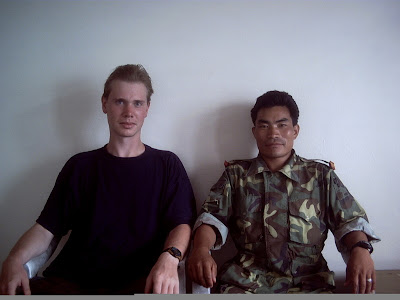
A Chance Encounter With a Maoist Commissar

It is notable that two years ago, before the ceasefire, the Maoists did not have any presence at all in Mustang due to the Royal Nepal Army’s occupation of a high foot suspension bridge below Ghasa that serves as the only entrance to the district below 5000 meters. Now the Maoists had a large visible office in Jomsom.


Neil Horning


Text of the interview with Pawan, the Mustang district in charge follows. I think it’s still a bit boilerplate.


1. The leadership has often said that the peace process was an unprecedented experiment for Maoism. In your opinion, what are the results of this experiment and the lessons to be learned?


When king Gyanendra used the Army to take power from the elected representatives We made the 12 point agreement in order to win back power with the help of all of the citizens. As we have been voicing the demands of the people, the old agreement was insufficient to fulfill these demands in the current situation so we are trying to make another agreement on the basis of a new consensus. The theme of this consensus must be to first announce a republic in order to uplift the different oppressed ethnicities genders regions and communities so they participate fully in the upcoming Constituent Assembly elections. For that the Communities of Women and Dalits must be given specific rights to participate in the interim government. Only then can the new Constitution be made in accordance to the will of the Nepalese citizens. This is the main aspiration of the Nepali Citizen today. Our party (Maoist) is always ready for that. Although we have joined the peace process, we are still integrating the strategies of People’s War and talks so there is less possibility of failure.


2. who do you think the public blames for the delay in the elections?

Since we started our People’s War to build the future of the Nepalese citizens we have waged the whole war for constituent assembly and we have written slogans on the walls saying “long live Republic, long live Constituent Assembly.” When we were doing this the Government [under the mainstream parties] arrested and even killed those people. And now the same people are blaming us for the delay. Shall we not remember that? Before the 19 day People’s uprising who was making the demands for Constituent Assembly and Republic? With this in mind, how can there be any confusion? Our 13,000 Martyrs sacrificed for Constituent Assembly and Republic so how can our party be against them? Therefore, those who were against them are the ones who are against Republic and Constituent Assembly.

3. What political development has most surprised you over the last year and a half?

Over the last year and a half we have concluded a huge ideological war. After the 12-point agreement we were able to isolate Gyanendra from the power of the Royal Army. Then we had the opportunity to speak freely among the Nepalese for whom we have been fighting for the last 11 years. As there is one army in this country of the government and one of the Nepalese citizens, we are able to force the government to give equal treatment to these two armies, as well as clear the charge made against us by the American imperialists that we are terrorists they had been popularizing to the world. Even now we are still trying to free the Nepalese government from the interference of European countries, America, and Australia who are exercising their hegemony. We are trying to balance the foreign strategies so we are not in the situation to be oppressed at their will. Our Party is the only party which is integrating all oppressed regions, ethnicities, genders, languages, cultures, all women and Dalits; understanding their sentiments in order to move them on the path of their liberation.

4. How have things changed for you personally over that time?

Things have changed so much since our last meeting because time is constantly moving [progressive]. According to that, human society is moving ahead. Therefor today’s Nepal is moving further ahead that yesterdays Nepal. In the same way, human society is becoming more conscious so there is a certainty of improvement. In the past there was an armed struggle of ideas. This category of struggle is not limited only to Nepal. It has become world wide because todays world has already become a fully integrated system. Finally, our ideological struggle is not only for Nepali citizens but rather for all the oppressed citizens of the world. Therefor, to have change in the politics of Nepal means to have change in the politics of the world.


Source: Blog for a Democratic Nepal, December 28, 2007

Nepal to be federal democratic republic

3rd amendment clears deck for republic

The Interim Parliament on Friday passed a third amendment to the Interim Constitution, stating that Nepal would become a federal democratic republic after the Constituent Assembly poll. Parliament amended Article 159 of the constitution. The amendment reads: "Nepal will be a federal democratic republic." The amendment also says the decision would be enforced by the first meeting of the Constituent Assembly." The amendment provides for parliament, through a two-third majority, to abolish the monarchy before the CA poll if the government is convinced that the king is conspiring against the poll.

The amendment also formally transfers the position of head of state to the prime minister. A proposal by lawmakers from the three biggest ruling parties to make new arrangements for the appointment of parliament's general secretary and secretary, has been incorporated in the constitution. Speaker Subas Nembang verified the bill Friday evening, bringing the amendment into immediate enforcement.

This is the third amendment to the Interim Constitution in less than a year. The constitution promulgated on January 16, 2007 was amended for the first time in March following a month-long Madhes movement, and for a second time on June 13 after the government's failure to hold CA polls by mid-June. Altogether 270 out of the 321 existing members voted in favor of the amendment proposal tabled by the government early this week. This number mostly comprises members from the three biggest parties-Nepali Congress, CPN-UML and CPN (Maoist).

Only three members -- Pashupati Shumsher Rana and Krishna Pratap Malla of Rastriya Prajatantra Party and Pari Thapa of CPN (United) -- voted against the proposal. Four members, two each from Rastriya Janashakti Party and Sadbhavana Party, boycotted the voting. Surya Bahadur Thapa, Renu Yadav of RJP and Rajendra Mahato and Yagya Jit Shah of Sadbhawana boycotted the vote. Altogether 44 members, including former speaker Tara Nath Ranabhat of NC and KP Oli and Jhala Nath Khanal of CPN UML, were absent during the voting.

Earlier, the House rejected amendment proposals tabled by RPP, RJP, National People's Front and Sadbhavana Party. The proposals by RPP and NPF to drop the names of the seven parties from the constitution, reduce the proposed number of seats in the CA and let the first meeting of the CA decide the monarchy's fate were rejected by overwhelming majority.

Amendment draws flak

Most opposition parties and some ruling coalition members criticized the constitution amendment Bill tabled by the government for its failure to address the issues raised by Madhesi, Janajatis and other agitating groups. Former prime minister and Rastriya Janashakti Party Chairman Surya Bahadur Thapa and Rastriya Prajatantra Party Chairman Pashupati Shumsher Rana alleged that the amendment was a blatant assault on the people's right to exercise sovereign powers.

"Constituent Assembly elected through fresh a mandate of the people is the only body that can exercise the people's sovereign power," said Thapa. "If this crucial decision is taken by the seven parties then where does sovereignty rest on?" He also warned of severe consequences because of SPA's authoritarian attitude. RPP Chairman Rana also claimed that it was solely the responsibility of sovereign people who can decide whether to declare Nepal a republic state or not. Similarly, Pradeep Giri of the ruling Nepali Congress criticized his party for denying lawmakers a chance for intense discussions on the serious political issues. He said the amendment has failed to address the genuine demands put forward by Madhesi people, but lawmakers could not take up the issues.

Rajendra Mahato of Sadbhavana Party warned that parliament would be without Madhesi members if there is no change in the attitude of the ruling big parties. Likewise, Pari Thapa of CPN-United, Chitra Bahadur KC of National People's Front, Sunil Prajapati of Nepal Workers Peasants Party and Kaman Singh Lama of People's Front Nepal urged the government to ensure the CA polls by addressing the issues raised by Madhesi, Dalit, ethnic and backward communities.
Source: Kathmandu Post, December 29

Nepal's Transition To A Full Republic

Vijaya Chalise

The seven political parties have again created history by signing a new agreement which, after the amendment of the interim constitution, will make Nepal institutionally a federal democratic republic. Following the agreement, the parliament as well has expedited the interim constitution amendment process. Ultimately, after days of delayed negotiations, the seven political parties have made commitment for a federal democratic republic in the interim constitution.
23-point agreement
The 23-point agreement has stated that the decision on the republic would be implemented by the first meeting of the Constituent Assembly (CA), but a two-third majority of the interim parliament will be required to implement the proposal of republic prior to the CA polls if the king creates any obstruction against the election. Therefore, the king now will not have any role in the state of affairs, and the Prime Minister will perform all works of the head of the state until the agreement on a republic gets implemented. Therefore, the agreement has set the stage for Nepal's transition to a full republic less than two years after the king was forced to cede his dictatorial powers following the Maoist's decade-long people's war along with the historic people's movement-2 jointly launched by the seven parties and the Maoists. Consequently, after the Nepali Congress agreed to declare the country a republic in the process of abolishing the monarchy - a key Maoist demand - the agreed document epitomises the seven-party alliance's commitment and desire to bring the peace process to a successful conclusion by holding the CA election.
The Communist Party of Nepal-Maoist (CPN-Maoist) has decided to rejoin the government. The CPN-Maoist that ended a decade-long people's war against the feudal regime had left the interim government last September demanding the declaration of Nepal a republic prior to the CA polls and implementing an all out proportional electoral system. The proclamation of a republic and the kind of electoral system to adopt had been the major points of dispute among the political parties. The Maoists had called for an immediate abolition of monarchy to ensure free and fair elections to shape the country's political future. The recent agreement has cleared the deck, and it has now assured the Constituent Assembly polls, which have been postponed twice. The parties have agreed too hold the CA elections by mid-April, 2008 and increase the number of CA members to 601, allocating approximately 42 and 58 per cent of the seats for the first-past-the-post and proportional election system respectively, with 335 to be elected under the fully proportional system, 240 through the first-past-the-post and 26 to be nominated by the cabinet. The nominees will be from among ethnic and indigenous groups who are not represented in the first-past-the post and the proportional system. Other provisions of the agreement include: the government will form commissions and committees within one month on the disappeared persons, truth and reconciliation, state restructuring, scientific land reform, and high-level monitoring of the implementation of the past agreements. The agreement for creating a high-level steering committee to ensure that the political stakeholders in the government have an equitable say and participation in running the affairs of the government within a week will obviously help eliminate the past impression over the way the government was run and conducted. Not only the Maoists but all the cabinet colleagues, except for the Congress ministers, had accused the head of the government of trying to seek monopoly over the decision-making process without taking them into confidence.
Prime Minister Girija Prasad Koirala says the 23-point agreement inked by the seven political parties has fortified the people's faith in the parties that was gradually waning. He claimed that the declaration of Nepal as a republic had already been made by the seven parties, which would be given final shape by including it in the interim constitution through parliamentary proceedings. However, some of the Madhesi factions, Rastrya Prajatanra Party (RPP) and Janatantrik Party (RJP) give the impression of being not happy. However, lawmakers of the seven political parties have welcomed the agreement and the amendment proposal of the government brought accordingly. Maoist chairman Prachanda said the new agreement that was forged among the seven parties had opened the way for the Maoists to participate in the government and that his party would take part in the election for a meaningful Constituent Assembly.Despite the positive development on the constitutional and political fronts, the people, however, may continue to voice their doubts until the election is held after declaring the fresh date. The seven parties should obviously protect the rights of the minorities, but one cannot forget that minority rights are not about allowing minority communities a free hand to spread hateful ideologies, but are about protecting the lives, livelihood and rights guaranteed by the constitution and laws of the nation.
While the country has now embraced a federal democratic republican structure, the agitating groups, including those in the Terai, have come for talks and support the new constitution-making process if they really are against peace and the disintegration of the country. Therefore, the government and the leaders of the seven-party alliance should seriously think of protecting the rights of such agitating groups so as not to give a chance to foreign actors to play their card at disintegrating the nation.Now, the government and the seven-party alliance should be serious about constituting the promised six commissions and committees within the agreed time frame. Since the Election Commission has demanded at least 90 days after the promulgation of all the election-related laws in the in the run-up of the poll, the government should not fail to implement all the agreements on time. If the government and the seven-party alliance work sincerely as per the letter and spirit of the agreements with broader understandings, a conducive environment for a constitution election could be created. The pre-requisites for holding the election are obviously the implementation of past pacts and understandings reached between the Maoists and the government and effective enforcement of law and order across the country.
Future course
As the country is passing through a very fluid political phase and national integrity and sovereignty is at risk with the delaying CA polls, decisions taken at the moment are important in determining and setting the course of the future of the nation. Therefore, the political parties should demonstrate perseverance and sincerity to ensure that the ongoing democratisation and peace-building process bears tangible fruits.
Source: The Rising Nepal, December 29, 2007

Thursday, 27 December 2007

Atrocities And 2008 Elections In Bhutan

T. P. Mishra
At a time when the election date is drawing nearer in Bhutan, the Royal Government of Bhutan (RGOB) has once again begun inflicting atrocities on innocent citizens of ethnic Nepali origin.ArrestsThe state-directed court recently announced jail terms ranging from 5-9 years to 30 innocent civilian from the southern district of the country for their alleged involvement in the Communist Party of Bhutan (Marxist-Leninist-Maoist). The RGOB claims the accused had carried out subversive activities against Bhutan.
How could the RGOB claim such a thing when it does not have an 'independent judiciary' in the country? A fair trial in the name of delivering justice to the detainees has always been a farce in the context of Bhutan. This is yet another instance of Bhutan's tactics to derail the repatriation of Bhutanese refugees, now living in camps in Nepal, to their homeland.Bhutan's official media, Kuensel, further stated that seditious meetings were held in Katarey and Ugyentse in Samtse, during which the participants planned to recruit the local people and set up camps in the forests to house the terrorists belonging to the CPB-MLM. Such fabricated statements are made by the Bhutanese government when its army arrests people especially of ethnic Nepali origin. The RGOB has charged them of being active during briefing sessions in Nepal on "Political and Ideological Trainings? conducted by the cadres of the Communist Party of Bhutan and Communist Party of Nepal, Bhutan People's Party, Druk National Congress and Bhutan Gorkha National Liberation Front. Ironically, the message Bhutan is sending to the international community is that the UNHCR is providing shelter to radical groups inside the refugee camps in Nepal.
The court is said to have sentenced them to jail under the provisions in the National Security Act of Bhutan, 1992, and the Penal Code of Bhutan, 2004. The people were accused of holding political meetings, especially related to Maoist ideology, in the country. Even if they were involved in such activities, what crime had they committed to be given jail terms of such long periods, especially at a time when the elections are fast approaching near? Is this, in any way, to hold a 'democratic exercise'? The RGOB, on the other hand, should have been encouraging the people in the country to get involved in the political exercise. Besides, the condition of hundreds of such detainees arrested in the early 1990s during demonstrations in the country is still unknown to the international community.Their whereabouts have not yet been made public. There is no one to publicise the conditions prevailing in the country.
It is a matter of shame that the RGOB should transform civilians into jailbirds for such a long period despite their innocence. The atrocities of the RGOB have crossed the limits, leaving enough space to raise questions about the effectiveness of the advocacy of international rights bodies and so-called big democracies of the world. Isn't Bhutan playing with the rights of the people, and would anyone believe that it is embarking on the path of democratisation? The surprising thing is - for how long will the international community stand mute spectators to all the atrocities that go around in Bhutan? A fair trail to the detainees is not possible in Bhutan. Even if these people belong to the Maoist militia, then Bhutan should have carried out an investigation in co-ordination with international human rights bodies.
Political restriction
In the meantime, on November 28, the Election Commission of Bhutan (ECB) stated that the leaders of the Bhutan People's United Party (BPUP) have no vision, goals and aspirations for a democratic Bhutan. Besides, in a notice, the ECB said it cannot register the BPUP as a political party in the country. The ECB's decision indicates that the party lacks persons with direct links with the royal family like Sangey Ngedup of the People's Democratic Party (PDP) and Jigme Thinley of the Druk Phuensum Tshokpa (DPT). While Bhutan is holding the first-ever elections in its history, the RGOB is trying to impose different restrictions on innocent civilians. Thus, there is little room to believe that the elections will be free and fair.There is a need for the world community, including international human rights bodies, to initiate noteworthy and stronger measures to provide justice to Bhutan's innocent civilians. The RGOB shouldn't be given a free hand in committing atrocities against its people.
Source: The Rising Nepal, December 27, 2007

Setting Date For CA Polls

CHIEF Election Commissioner Bhoj Raj Pokharel is back again on the centre stage of political and constitutional discussion as the onus of holding the polls to the Constituent Assembly is shifting to the mantle of the constitutional organ, following the 23-point agreement formalised by the Seven-party Alliance recently. It is in line with the responsibility and mandate of the Election Commission to demand that the political parties accelerate the process of finalising the constitutional and legal modus operandi according to the new agreement.

Needless to repeat, the alliance has agreed to increase the number of seats in the proportional representation mode of polling, which does naturally require adjustments and changes both in the interim constitution and law relating to the election of the members of the Constituent Assembly. If the experience from the past is anything to go by, it had taken months for the parties to devise and ratify the Constituent Assembly election law. The law makers had taken most of their time in discussing and finalising the criteria for distribution and reservation of seats to the different marginalised and disadvantaged groups, including the women. However, as a framework has already been laid down in the statute, not much time should be spent by the lawmakers to arrive at a conclusion for appropriating the reserved seats to the marginalised and disadvantaged groups that have been already identified by the law.

However, should the political stakeholders repeat the previous tendencies of raking up one issue after another, it might take more time than anticipated to finalise the relevant legal instruments. This will affect the entire process of setting schedules for the polls to the Constituent Assembly. As said by the Election Commissioner, the constitutional body needs at least 90 days to complete all the procedures in the run up to the election to the Constituent Assembly. Though several other corollary instruments and guidelines have been in place, the most important law setting forth the process of electing the members of the Constituent Assembly needs to be revised, taking the new changes and amendments into account. As emphasised by the Chief Election Commissioner, the government should waste no time in ensuring that the date for the Constituent Assembly polls is announced soon and the necessary legislative instruments are ratified.

Source: The Rising Nepal, December 27, 2007

Maoist trouble at border

India might have had its own share of problems due to border disputes with China and Pakistan for decades, but Nepal could well prove to be an additional concern, with Maoists joining the Girija Prasad Koirala government recently.
India, on Tuesday woke up to an attempt by around 200 Maoist ultras from Nepal trying to stake a claim on a stretch of the “no man's land" after crossing the porous international border touching Uttarakhand. They tried hoisting red flags in the area, close to Banbasa town in the border district of Champavat, before they were accosted. “Previously, border pillars with numbers 3 and 3-A used to mark the border with Nepal. However, they were uprooted due to various reasons. Of late, there have been efforts to conduct a joint survey by the two countries of the nearly 300-km stretch of the Indo-Nepal border to identify areas where the border pillars are missing and to restore them," said superintendent of police of Champavat MS Bangyal.

Bangyal said the Nepali Maoist ultras, who tried to hoist the flag belonged to the Young Communist League, a wing of the Nepal Communist Party. "Although the Nepali Maoist ultras' bid to hoist their red flag was foiled by the security forces they had a design behind that," the official said. "They tried their best to provoke the security forces to open fire on them, as any casualty on their side could become an international issue," he added.

Stating that the security forces showed restraint and pushed the Maoist ultras back to Nepal, the SSP said. "They tried to enter the 'no man's land' from Gadda Chowki area near Banbasa town. We had information from Nepali authorities that they would try to enter through Brahamadev town of Nepal," he added.
Source: Hindustan Times, December 27, 2007

Wednesday, 26 December 2007

Nepal: India’s “Design Next”

Niraj Aryal

Kathmandu, Niraj Aryal: It’s hardly been two weeks Nepal’s Army Chief, Rukmangad Katuwal returned home from the Indian pilgrimage wherein he was reported to have been offered a “red carpet welcome” by the Indian establishment. Reportedly, Nepal’s Army Chief met the Prime Minister, Home Minister, Defense Minister and India’s national security advisor, to name a few in the list of the movers and shakers of India’s politics whom he met during his short stint there, though he was also reported to have traveled to South to get a glimpse of the living Indian deity Sai Baba- whose followers could well be found here in Nepal. More importantly, Katuwal, unsubstantiated though reports, met the outgoing chief of India’s notorious intelligence agency RAW (Research and Analysis Wing), Ashok Chaturvedi, two times in merely fifteen days, first in New Delhi and the next meet took place right here in Kathmandu, when the later had sneaked into Kathmandu for a four day stint, last week. The RAW chief reportedly, stayed at the Hyatt regency Hotel in Kathmandu.
It could be a mere conjecture only but Katuwal’s return home coincided with the Nepal Army refuting claims made by some newspapers in Nepal. The newspaper reports quoting the Maoists’ leadership had it that talks were on in between the Maoists leadership and the Nepal Army’s high ranking officials to initiate steps towards integrating the Maoists’ militias within its domain. However, to the dismay of the Maoists’ leadership, the NA in its refusal statement held that, “…it was merely a ploy to malign the credentials of the National army”. The question is thus as to whom from the two camps were lying? Obviously, the Maoists who have the habit of making false revelations now and then would be adjudged making fool of the people more so, the media. “But there are proofs of such meets taking place at least three times in the past between the two rivals of by gone era”, said Padma Ratna Tuladhar-the leftist rights activist, talking to a local FM radio station here in Kathmandu, Monday, December 24, 2005.
Now, the point is that if the statement coming form the Army camp is not just a mere conjecture and according to Mr. Tuladhar a false claim, then there must be something underneath. The point here is that such views were being aired by the Maoists’ leadership since long, at least from over a month or so, but the NA statement came only after Katuwal returned home from Delhi trip, obviously a delayed statement. What does this indicate then, perhaps only that India does not want the National Army to unite with the Maoists’ Militias- makes no difference that agreements were made in between the real stakeholders of Nepali politics in the past in regard to the integration of Militias into the National Army? Which, say analysts, the Indian leadership might have aired Katuwal when they met him in India. Obviously, they needed that as well, only because they might have started feeling the brunt of elevating the ranks of the Maoists in Nepali politics and that too at a time when the Militias were possibly, though only limited in theory, being integrated into the Nepal Army. The Militias who have been indoctrinated of the anti-India sentiments by their leadership throughout the rebellion period and even asked to build trenches to fight the real enemy-India (sic Maoists’ leadership), India does not want that to happen either.
Back to Katuwal again, if Indian leadership can talk differently to different Nepali political leadership, it is anybody’s guess that Katuwal too was told something completely different. What the leadership there told Katuwal verbatim is difficult to comprehend but it is for sure that strong “NO” signal to the possible NA-Maoist Militia merger was whispered into Katuwal’s ear. If not, why the NA was claiming that their much publicized meeting with the Maoists’ leadership was false?

To add to the point as to why India does not want NA-Maoist Militias merger, it might also be because India in the past had submitted proposals to then rulers to minimize the size of the security personnel here only to hand over Nepal’s security stakes to India. Such Indian designs only became public after such successive regimes failed to prevail in Nepali politics. Take for instance, what the then Prime Minister Marich Man Singh had told during a mass meet in Kathmandu. Mr. Singh had claimed that India had submitted a proposal to King Birendra for handing over Nepal’s security matters to India, be it the security issues, internal one or external both, if the system of Panchayat was to continue. After few years as Gyanendra-most probably Nepal’s last monarch, took over after King Birendra got killed in an inner family feud, he too was forwarded with a similar proposal which were only but rejected on both the occasions. Gyanendra toeing his brother Birendra’s footstep rejected such an offer, which could have otherwise ensured longer life for his unpopular regime in the country.
The point here is that with the possible integration of the Maoists Militias with the National Army, the strength of the National Army will be enhanced numerically. This, in essence, is what India does not want in any pretext or the other. And that is also against India’s age old doctrine outlined by none other than Jawahar Lal Nehru- India’s first Prime Minister.

Then, all of a sudden and that too close on the heels of Katuwal’s India visit, the outburst of India’s PM Man Mohan Singh against the Maoist rebels operating in India comes. Mr. Singh, otherwise, a lame duck prime minister, making sharp comments against the Maoists even called their movement as the single biggest security threat to his country and also dubbed the Maoist as a "virus".
Singh was addressing a conference on internal security attended by the chief ministers’ of the Maoists affected States in India last week wherein he vowed to take stringent measures against those involved in Naxal activities. However, only few years’ back, Mr. Singh while addressing a similar conference had said the same thing but in the mean time the Naxal movement there only got amplified with the working class exploited more as a result the development indices rose sharply and also unexpectedly.
Now that there are concrete proofs that the Nepal Maoists are indulged in activities aiding their Indian counterparts (so claim Indian media reports), it is only but natural that India would love to see a quick downfall of the Maoists in Nepal. But to the utter dismay of the analysts here, how India proceeds in its “Design Next” in Nepal is difficult to comprehend at least for the moment…however, it is simple to say that as the return of Kingship in Nepal is becoming more and more difficult, the NA might be lured instead in the future to counter the Maoists.
Source: Telegraph Nepal, December 26, 2007

Unstable Nepal poses security threat to India

Centre feels feuding parties in the Himalayan kingdom will precipitate crisis along border
Seema Guha
NEW DELHI: India has officially welcomed Nepal’s decision to hold national elections by April next year, but privately there is serious concern that the Himalayan kingdom’s feuding political parties may not be able to sustain the current arrangement leading to a fresh crisis in its vulnerable eastern border.
Nepal has been a constant cause for worry for India’s policy planners ever since the strain within the political parties surfaced earlier this year. New Delhi realises that an unstable Kathmandu is a major security concern for this country which shares a long and unguarded border with Nepal.
Apart from security, India is not happy with the growing presence of the United Nations in the region and wants the international agency to wind up its mission as soon as possible. Prime Minister GP Koirala has for the moment been able to cobble together a 23-point agreement among the seven warring political parties. In the process, he had to give in to the Maoist demand for the abolition of monarchy by the parliament.
The prime minister and his party had wanted to play by the book and had plans to bring in constitutional changes only after fresh election gave a democratic mandate to Parliament. But the Maoists had walked out of the government and refused to yield ground, leading to the prime minister finally caving in to the Maoists.
Source: DNA, December 26, 2007

Thursday, 13 December 2007

Madhes unity

Last week saw an unprecedented consolidation of forces in Madhes. First, it was the declaration of unification by three armed rebel groups—the two factions of Jwala Singh and Bisphot Singh of the Janatantrik Tarai Mukti Morcha and the Tarai Tigers. Then came the announcement of the establishment of the Madhes Liberation Front formed by the merger of the Rajendra Mahato faction of the Nepal Sadbhavana Party (Anandi Devi) and Upendra Mahato's Madhesi People's Rights Forum (MPRF). A ground-breaking development took place on Monday with the announcement of a new political front in the tarai. Mahanta Thakur, a senior Madhesi leader of the Nepali Congress, resigned his ministerial position and parliamentary membership to lead the front. One lawmaker each from the Nepal Sadbhavana Party (Anandi Devi), CPN-UML and RPP quit their parties to join hands with Thakur. Many more senior Madhesi leaders from other political fronts are expected to jump on the bandwagon.

The obvious questions are this: How did such a sudden consolidation of forces happen in the tarai? What will its ramifications be? The consolidation of power will definitely augment their influence in the tarai. However, the formation of a front of armed groups is definitely not going to help the taraibasis. It will only make things worse for them. In fact, the political leaders, who were until now associated with different parties, were compelled to do something in order to offset the ever-increasing threat and influence of gun-slinging bands in the tarai. They who have been demanding autonomy and vowing to attain their goals through a peaceful movement will hopefully help the government improve the pathetic law and order situation in the tarai. We hope that both the Tarai Liberation Front and the new front announced by Thakur and others will at least make the tarai livable for people from all regions and castes. However, if these groups get tempted to establish working relations with any armed group, then the tarai situation will turn from bad to worse.
The emergence of new groups is also revenge of the Madhesi leaders against the parties they were associated with. Had the seven-party government acted promptly and addressed the law and order situation and other valid demands, the leaders would not have been forced to form new political fronts. The formation of these new fronts will probably also convince the Maoists that the Madhesi movement was not waged by the NC and the UML just to minimize their influence in the tarai. However, it is yet to be seen if the Maoists can stop their Madhesi leaders from joining one or the other front. The Post believes that the armed groups should be dealt with sternly by the government, but the unarmed and peaceful groups should be allowed to grow as political parties. We hope the peaceful political groups will dissociate themselves from anti-social elements and de-escalate the ethnic acrimony in the tarai.
Source: The Kathmandu Post, December 12, 2007

Nepal is heading for regional polarisation

Paul Soren
The continuing crisis in the Tarai region in Nepal remains a serious challenge for the present interim government and has only been aggravated by recent events when a group of legislators from the Tarai, resigned from the parliament on December 10. This led to further political impasse and uncertainty towards holding of the Constituent Assembly (CA) polls. The senior Nepali Congress leader and Minister for Science and Technology in the present government, Mahant Thakur, considered to be a very close aide of Prime Minister Girija Prasad Koirala, along with three other influential Tarai leaders, Hridayesh Tripathi formerly with (Nepal Sadbhawana Party-Anandi Devi), Mahendra Yadav of (Communist Party of Nepal-Unified Marxist Leninist) (CPN-UML) and Ram Chandra Raya of Rastriya Prajatantra Party resigned from the parliament alleging that the government and parties are insensitive and indifferent towards resolving the problems of the Tarai region.
They accused the government of not fulfilling past commitments given to the Madhesi parliamentarians. After resigning, these leaders also announced the formation of a new political outfit in the Tarai. The party would start a fresh round of peaceful agitations to pressure the government to fulfill their demands. Subsequently, five political leaders from Tarai; Sarbendra Nath Sukla of Rastriya Janashakti Party, Anish Ansari, Ram Chandra Kushwaha and Brishesh Chandra Lal of NC and Srikrishna Yadav of UML, followed by resigning from their respective party positions, and accused their parent parties of indifference towards Tarai issues. Moreover, reports suggest that many more leaders and party members from Tarai, holding positions in different parties, are planning to quit their parent parties and join hands to form a new political outfit.
The Tarai problem has its genesis in history where the Madhesis have felt alienated and discriminated in political, social, cultural and economic affairs and have continually been searching for an identity. The Madhesis have become more conscious of their rights post Jana Aandolan II and over time several new political outfits and some underground armed groups have emerged. Though initially the agitations, demanding for federal system with regional autonomy, amendment in interim legislature, rights to self-determination and proportional representation in the CA polls, were peaceful but later became violent. They also seek a legislature that would legislate on behalf of the Madhesis. After initial hesitation, the Madhesi movement gathered strength in unity while the government’s apathy and the political vacuum created in the Tarai, helped. The call to form a new political outfit representing the sentiments of the Tarai could polarise the polity.
A few months ago, a prominent leader from NSP-A (a Tarai political outfit), Rajendra Mahato and Upendra Yadav, Chairman of the Madhesi Janaadhikar Forum , have already announced the launch of a joint front called Samyukta Madhesi Morcha which announced a joint agitation from end of December. A new and stronger political force in the region can be expected to give a new life to the agitation for a federal set up in the country. A sustained movement will put pressure on Kathmandu to try to solve the problem. Any delay in this would encourage underground armed groups in Tarai and the newly formed Madhes Rakshya Bahini the youth wing of the SMM to resort to violence with its usual consequences in an already unstable situation. Since most of the industries in Tarai have already shut down any further turmoil will force the remaining industries to also close down. More importantly, this will also affect the already shaky peace process and delay the holding of CA polls.
Source: Observer Research Foundation, New Delhi, December 12, 2007

Koirala willing to declare Nepal a republic: report

The paralysis gripping Nepal's fragile peace process for nearly three months could be easing with Prime Minister Girija Prasad Koirala finally agreeing to abolish the kingdom's two-century-old institution of monarchy and declare Nepal a republic, according to the Maoists.
Koirala and his Nepali Congress party - so far the major opponents of the Maoist demand that King Gyanendra be sacked immediately through a parliamentary decree - have shown signs of relenting, with the prime minister partially agreeing to the proposal of a republic, the Janadisha daily, the Maoist mouthpiece, reported on Wednesday. After several rounds of parleys, Koirala is now ready to amend the constitution that, though stripping the king of all powers and privileges, left the crown in a state of suspension, decreeing that an election would decide its fate.
Now, however, Koirala is ready to revise the constitution and abolish the crown before the election, as demanded by the Maoists. The rebels had asked the parliament to effect the change, alleging that a free and fair election would not be possible as long as the king remained. Although the majority of legislators supported their demand, the rebels were not able to push it through because they needed two-thirds majority, which eluded them because the Nepali Congress, the biggest party in the house, opposed them. Koirala's capitulation comes with a condition, the Maoist daily said. He is proposing that though Nepal would be declared a republic, the king should not be evicted from his palace immediately. The implementation would start only after the election.
This, incidentally, is also part of the peace formula suggested by former US president Jimmy Carter who visited Nepal last month to bring the warring sides together. It would also get the support of the international community that has been urging the government to hold the election and let it decide the king's fate. However, the daily also said that Maoist chief Prachanda is pushing for the immediate implementation of a republic. While the deadlock on monarchy could be inching towards a consensus, the two parties still remain divided over a second Maoist demand. The rebels also want a fully proportional electoral system, which is likely to improve their electoral chances.
While Koirala was opposing it at first, now he is ready to accept a 40 to 60 compromise in which 60 per cent of the seats would be elected as per the Maoist demand and the rest on the first past the post system, the report said. Earlier, Prachanda had indicated that if the demand for a republic were to be conceded, his party would be flexible about the second. Koirala's thaw was partly due to the growing pressure at home and abroad to reach an understanding with the Maoists and hold the twice-deferred election by April.
A new impetus came after his trusted Minister for Science, Technology and Environment Mohanta Thakur resigned on Tuesday along with three MPs from the Terai plains to form a regional party and push for autonomy in the restive plains. Both the Nepali Congress and the Maoists are concerned at the move, realising their control in the plains is diminishing. Any further delay to hold the polls could spell disaster for them in the Terai, which is emerging as the new x-factor in Nepal's politics.
Source: Hindustan Times, December 12, 2007

PLA and NA Question Of Integration

Shyam Bhandari

Addressing the seventh anniversary of the armed wing of the Communist Party of Nepal (Maoist), the People's Liberation Army (PLA), in Chitwan recently, Maoist Chairman Prachanda is reported to have ruled out any possibility of the Constituent Assembly (CA) elections unless the peace process moved ahead properly. Nothing new! The Maoists have made the CA polls a bargaining chip before, and it seems they will go on making it just until their hidden agenda is met.
For now, the Maoists do not seem to be quite keen to set a new deadline for the CA polls in a hurry. Their insistence on the government first agreeing to adopt the proportional representation system of election and abolition of monarchy outright have come in the way of the elections being scheduled the last time around. Going by Prachanda's declaration in Chitwan, it's anyone's guess that new thorns are sprouting even if the existing ones get cleared somehow.
New thorns
There is every indication that the Maoists will come up with a new set of demands if the present ones are met. Needless to say, their oft-repeated allusion to the integration of the PLA with the Nepal Army (NA) is the new thorn that is emerging in the paths of the ever-elusive CA polls. As far as the Maoists are concerned, it is commendable that a force that was married to bloodshed has come as far as it has in its new role as a peaceful, though not overtly genuine, participant of a political process. However, neither the Government of Nepal nor the Maoists have been fully implementing the commitments they inked in the Comprehensive Peace Accord of last year.
In fact, they have turned each other's shortcomings in fulfilling the commitments into a post-conflict conflict. While the government harbours an overabundance of tacit bitterness against the Maoists for not reining in its various organs, including the YCL (Young Communist League), that are involved in making the law and order situation go haywire, the Maoists have been more vocal in their accusations. They have been availing of every possible opportunity to point accusing fingers at the government for ignoring the promises made to them. Prominent among the accusations is that of the government's apathy towards its fighters enclosed in the cantonments under the watchful eye of UNMIN. The Maoists want their fighters to be integrated into the NA with the greatest urgency. Time and again, Prachanda has underlined that the integration process was delayed due to the government's indifference and the lack of interest over the issue among the concerned parties. He has been insisting on settling the PLA issue before continuing on the journey towards the CA polls.
Why is Prachanda so keen on doing this? Is this more important than the mammoth task of writing a new constitution, more important than rewriting the very politico socio-economic foundation of a New Nepal? From the Maoist perspectives, yes! Prachanda has every reason to be wary of the PLA fallout in the event of his party not meeting what they were promised during the hard days of the 'war' or during 'recruitment' - whichever may be applicable. It is an open truth that his party recruited every possible Tom, Dick and Harry with inflated promises both during the years of active conflict and post-CPA. The result - 33,000 armed and trained indoctrinates who are constantly itching for action - is certain to weigh down on his back. It is becoming more and more evident that the real issue behind the Maoists' refusal to wake and shake themselves up for the remaining leg of the journey in the peace process is the reintegration of their fighters more than the issue of Monarchy or the representation system. That the Maoist chairman is hell bent on fulfilling the promises he made to his cadres is evident from his stance. What about the promises he and the other signatories and participants of the CPA, and later the government, made to the remaining people? These self-proclaimed people's leaders seem to have their own definition of 'people'.
Just as his party cadres are the only people in the eyes of the Maoist supremo, so it is for Girijababu, MaKuNe (Madahv Kumar Nepal) and others. What happens to the large chunk of the population that is sidelined when each of the leaders works to milk the most out of the public coffers for the benefit of a chosen few? When will these narrow-minded leaders learn to work for the benefit of the people and the nation as a whole?
Question of integration
As far as Prachanda's proclivity for the integration of his army with the NA goes, it doesn't look viable both from the military as well as the general perspective. You can't expect two forces that faced each other in the killing fields not long ago to share the same bed and breakfast, especially with both armed to the teeth. Moreover, the Maoists were themselves trumpeting, and correctly so, until a year ago saying that Nepal doesn't need an army as large as it presently maintains. How come they suddenly seem comfortable with adding another 30,000 to that already oversized lot? But then there is still the question of how we can demobilise and reintegrate the ex-combatants from the Maoist camp. There is a middle path that can both reintegrate the Maoist PLA while downsizing the NA.
What we can do is create an unarmed reconstruction and development force by incorporating the Maoists and a sizeable chunk of the NA into a Public Works Department (PWD). The work this department can do will include building roads and bridges, schools, community hospitals and other projects. It could also be mobilised for relief work during emergencies and natural disasters. The government can pay them at par with the NA soldiers, while saving a huge sum on arms and ammunition that it would need to buy for them otherwise. This would also serve as a purgatory for the Maoists that so unfeelingly destroyed the infrastructure of this country during their people's war. It would be a win-win for Prachanda for he could tell his fighters that he kept his word, while the rest of us could do with a long speech on how he trimmed the NA for the benefit of a New Nepal.
Source: The Rising Nepal, December 13, 2007